Evolve your traditional lead scoring in 2026

TL;DR
In 2026, lead scoring is no longer limited to assigning a number to each lead: it has evolved into intelligent systems that detect real intent from complex behavior patterns, not just static rules. Predictive lead scoring transforms historical data into actionable insights, allowing companies to prioritize leads with the highest probability of conversion and reducing commercial noise and false expectations. The true objective is not to sell more, but to sell better with focus and precision.
Key Terminology Glossary
Term | Definition |
Predictive lead scoring | Automated evaluation of leads based on AI that predicts conversion probability. |
Lead intent | Signals indicating that a lead is not just interested, but ready to move forward. |
Micro-signals | Small, combined actions that reveal real intent. |
No linear behavior | Funnels tend to be more complex adding more layers, more stages. This adds caos to the lead's behavior. |
Rule-based lead scoring | Traditional lead scoring solutions assign scores based on a specific predefined set of rules. |
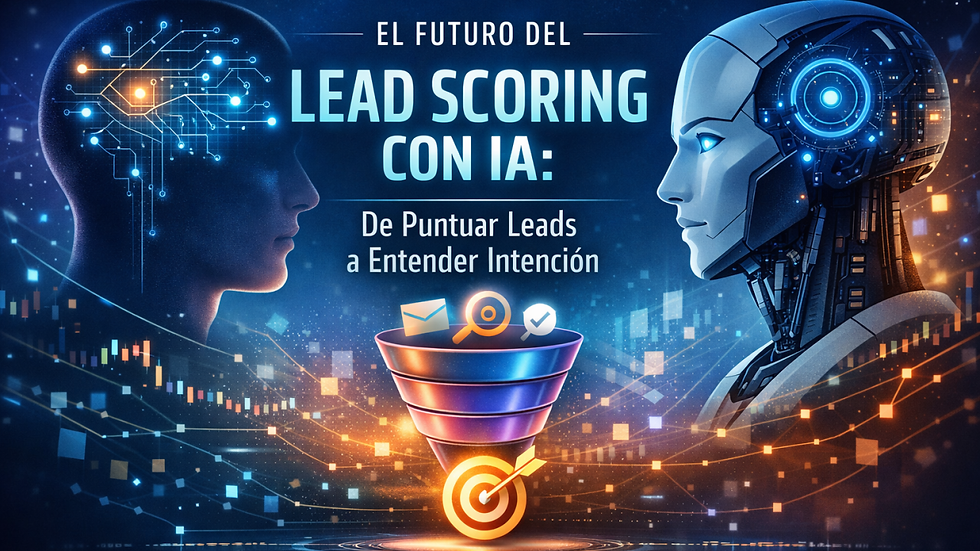
What Changes in 2026?
Traditionally, lead scoring consisted of assigning a number to know who to contact first. That approach worked for years, but now:
Decision cycles are longer
Lead behavior is less linear
Rigid rules no longer represent the real complexity of the customer
👉 In 2026, the question shifts from “Is this a good lead?” to “What is the intent behind their behavior?”
Evolver your Lead Scoring in 2026
Before: simple rule-based scores.
Now: models that interpret signals like:
Interaction sequences
Temporal rhythms
Combinations of micro-signals
This means moving from isolated data to data with context, something that AI can analyze with precision.
The Shift from Number to Insight
Modern AI-based systems have several competitive advantages:
They learn from real historical data, not predefined assumptions.
They adapt to market and behavior changes.
They detect micro-signals that a human would miss.
They separate true intent from simple curiosity.
This new approach continues to prioritize leads but it also protects the sales team from unproductive efforts.
The True Objective: Selling Better
A common mistake is thinking that lead scoring is for “selling more.” The true objective is to sell better, with less noise and more focus.
When a lead scoring system is well-built:
The sales team trusts the scores
Marketing optimizes for quality, not volume
Sales conversations happen at the right time
Are you looking for an AI-powered Lead Scoring tool for 2026?
I’ve put together an article featuring a top selection of the best solutions on the market,
so you can choose the one that best fits your sales process. Don't miss the chance to evolver your lead scoring in 2026.

Comments